
The SEO world never sits still. This week, Google made two moves that affect how users experience websites — and how AI is changing the way people search. Let’s break it all down in simple words.
What is back button hijacking?
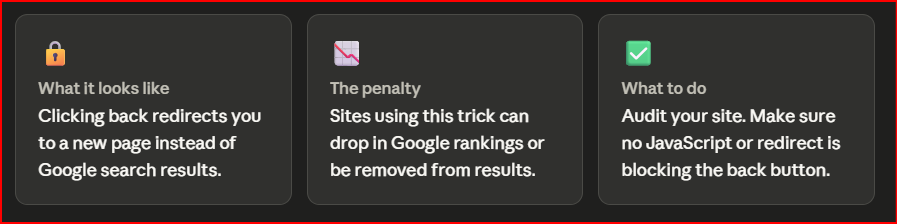
You know that frustrating feeling — you visit a website, click the back button to go back to Google, and instead you get stuck in a loop? The page sends you back to itself again and again. That trick is called back button hijacking.
Some websites do this on purpose. They want to keep you on their page as long as possible, even if you clearly want to leave. It’s annoying. It’s a bad experience. And Google has now officially said: enough.
The short version: Google is now penalizing websites that trap users using the back button. If your site does this — even by accident — it could hurt your rankings.
Why did Google crack down on this?
Google’s whole mission is to help people find useful information quickly. When a website hijacks the back button, it works against that mission. Users feel frustrated and trapped. That leads to a poor experience — and Google cares a lot about experience.
Google looks at signals like how quickly people leave a page, whether they come back to search results, and how long they stay. A site that traps users with back button tricks actually sends bad signals over time. Now, Google is making the penalty more direct and clear.
What should website owners do right now?
If you run a website, this is a good time for a quick check. Ask your developer to test what happens when a user hits the back button from any page on your site. It should go straight back to where they came from — simple as that.
Common causes of accidental back button hijacking include popup scripts, redirect chains, and some advertising tools. These can trigger the issue even if you never intended it. A clean technical audit will help you spot the problem fast.
Quick tip for site owners
Test your site in Google Chrome. Go to your page, then press the back button. If you stay on the same domain or get bounced to another page instead of your starting point — that’s a red flag worth fixing.
Now the bigger story: agentic search is growing
The second big shift this week is about how people are beginning to use AI to search the web. This is called agentic search — and it is changing SEO in a deep way.
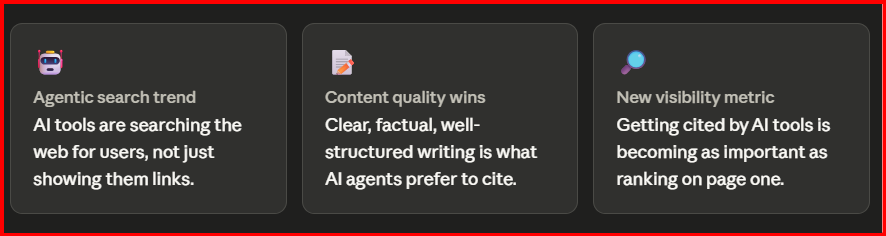
Traditional search is simple: you type something, Google shows ten links, you click one. Agentic search is different. An AI agent searches the web on your behalf. It reads multiple pages, puts the information together, and gives you an answer — without you clicking anything.
“Agentic search doesn’t just find a page — it reads it, understands it, and summarises it for the user.”
This is already happening inside products like Google AI Overviews, ChatGPT browsing, and various AI assistants. The user asks a question, the AI does the searching, and the user gets a clean answer. No scrolling. No clicking ten tabs.
What does this mean for SEO?
For years, SEO has been about getting to the top of the Google results page. But if AI agents are reading your page and summarising it — you might never show up as a clickable link at all. Your content still matters, but the way it reaches the user is changing.
Here is the new reality: your content must be easy for AI to understand and trust. That means clear structure, accurate information, good headings, and a fast-loading site. If your content is messy or full of fluff, AI agents will skip it and use something better.
How to prepare your content for agentic search
The good news is that what works for agentic search is just good writing and smart structure. Here is what you should focus on:
Write clear answers early. Put the main answer or key point in the first two sentences of each section. AI agents often grab the top of the text. Do not make them search for the point.
Use real facts and data. AI agents are trained to look for trustworthy information. If you have stats, dates, and source-backed claims, your content looks more credible.
Keep your structure clean. Use proper headings (H2, H3). Break text into short paragraphs. Avoid walls of text. If a human finds it easy to scan, an AI agent will too.
Cover topics fully. Thin content — a short page with barely anything on it — will not survive in an agentic search world. You want pages that genuinely answer questions in depth.
Bottom line for SEOs
The future of SEO is not just about ranking — it’s about being the source that AI agents trust and use. Write for humans first, but make it easy for AI to read and cite.
The takeaway from this week
Two very different updates — but they both point in the same direction. Google and AI search tools want the same thing: good content, clean websites, and happy users. Remove tricks that frustrate people, and write content that genuinely helps them. That is the SEO of today and tomorrow.
If you have a website, run a back button test this week and take a look at your content quality. Small fixes now can protect your traffic for the months ahead.